














Colorado Sues EarnIn For “Immoral, Unethical, Oppressive and Unscrupulous” Business Practices
Hey all, Jason here. When this hits your inbox, I should be en route to the airport — not to go anywhere myself, just to pick up my better half. I must admit, it’s been strange to be home alone (well, with two dogs) for two weeks! Really lets me “optimize” to spending more time on reading/writing/working, whether that’s healthy or not! Looking forward to getting back into a (somewhat) more balance routine. Subscribe or Support by Upgrading Compare Notes With the People Who Built Modern Fintech Partner content: Remitly CEO Sebastian Gunningham. Increase founder Darragh Buckley. Linda Du, Co-founder & President at Valon. They’ll unpack the decisions behind building and scaling major financial products: what they got right, what broke, what they would do differently, and how AI and new infrastructure are changing the operator playbook. Most events tell you where fintech is going. NerdCon puts the people who built the present in the room and asks them what comes next. Expect an operator-led conversation grounded in real products, real trade-offs and lessons earned the hard way. Fintech Business Weekly readers save 20% on Regular tickets with code FBW20 before standard pricing ends September 11. Meet the Builders Things To Know & Other Good Reads Advent and Stripe Abandon $50 Billion Pursuit of PayPal (Bloomberg) Trump Family’s New Crypto Bank Is Backed by Abu Dhabi Sheikh (Wall Street Journal) The multiplying risks of financing data centres (FT) Let the Bond Market Speak (Wall Street Journal) Did we waste a crisis? Modest proposals to reform deposit insurance. (Fintech Takes Banking) Untangling Guggenheim: How Private Credit Built Its Own Universe (Net Interest) The Hater’s Guide To Circular Financing — Part One (Ed Zitron) Fiat Ventures Rebrands to FGV Capital, Announces $35M Oversubscribed Fund II (BusinessWire) Socure Announces Strategic Growth Investment at $5.2B Valuation and Acquires Agentic Operations Platform Fravity (Socure) Listen: When Consumer Protection Disclosures Work Too Well (Consumer Finance Monitor Podcast) Colorado Sues EarnIn For “Immoral, Unethical, Oppressive and Unscrupulous” Business Practices When Andreessen Horowitz led EarnIn’s $39 million Series B in 2017, Alex Rampell, a partner at the storied venture capital firm, described EarnIn’s small-dollar advance product as “free,” relying on “entirely on voluntary contributions instead of fees.” Rampell favorably compared EarnIn’s approach to typical payday loans, writing, “Payday loans historically have had the potential to be a slippery slope for consumers into financial distress: opaque systems and steep fees that are hard to repay and set individuals back further than where they started. For many Americans living paycheck to paycheck, that kind of slide into debt can be extremely difficult to recover from.” But EarnIn’s product — which, the company says, isn’t a “loan,” legally speaking — ends up being anything but free for most users. While it is technically possible to take a no-fee advance from the company, most users incur “Lightning Speed” (instant funding) fees and/or ostensibly optional tips that combined can equate to annualized percent rates that can reach over 1,000%. With an average term of 9.77 days, even fees and tips that are small on an absolute dollar basis are equivalent to high APRs on an annualized basis. A lawsuit filed last week by Colorado Attorney General Phil Weiser against EarnIn describes the company and its product and business practices quite differently than Andreessen’s Rampell; “EarnIn’s business practices are unfair because they are immoral, unethical, oppressive and unscrupulous,” the complaint, filed in District Court in Denver, Colorado, says. EarnIn’s marquee product, Cash Out, isn’t a loan, the company says, as Cash Out is not “[f]orward [l]ooking” because “[t]he money is transferred based on earnings to date,” does not carry a mandatory fee to access funds, and is “non-recourse,” meaning EarnIn cannot pursue recovery from users who don’t repay advanced funds. EarnIn is sometimes referred to as an “Earned Wage Advance” service. Though, unlike some others in the broader category, EarnIn does not integrate with employers’ payroll or time and attendance systems. Rather, EarnIn attempts to verify a user’s income and employment, by examining direct deposit transaction data in their linked external bank account, by using GPS location and Bluetooth data to estimate a user’s time spent at work, if they work in a fixed location, and/or by having a user provided a work email address. While repayment is theoretically optional, as EarnIn would have no recourse, such as reporting non-payment to the credit bureaus or a collections agency, this is anything but clear to users of the EarnIn app, Colorado’s complaint argues. During the process of taking a Cash Out, users must agree to a preauthorized debit of the amount advanced, plus any expedited funding fee and/or tips. Though users technically can revoke this ACH




Hey all, Jason here.




When this hits your inbox, I should be en route to the airport — not to go anywhere myself, just to pick up my better half. I must admit, it’s been strange to be home alone (well, with two dogs) for two weeks! Really lets me “optimize” to spending more time on reading/writing/working, whether that’s healthy or not! Looking forward to getting back into a (somewhat) more balance routine.
Subscribe or Support by Upgrading
Compare Notes With the People Who Built Modern Fintech
Partner content: Remitly CEO Sebastian Gunningham. Increase founder Darragh Buckley. Linda Du, Co-founder & President at Valon.
They’ll unpack the decisions behind building and scaling major financial products: what they got right, what broke, what they would do differently, and how AI and new infrastructure are changing the operator playbook.
Most events tell you where fintech is going. NerdCon puts the people who built the present in the room and asks them what comes next.
Expect an operator-led conversation grounded in real products, real trade-offs and lessons earned the hard way.
Fintech Business Weekly readers save 20% on Regular tickets with code FBW20 before standard pricing ends September 11.
Things To Know & Other Good Reads
Advent and Stripe Abandon $50 Billion Pursuit of PayPal (Bloomberg)
Trump Family’s New Crypto Bank Is Backed by Abu Dhabi Sheikh (Wall Street Journal)
The multiplying risks of financing data centres (FT)
Let the Bond Market Speak (Wall Street Journal)
Did we waste a crisis? Modest proposals to reform deposit insurance. (Fintech Takes Banking)
Untangling Guggenheim: How Private Credit Built Its Own Universe (Net Interest)
The Hater’s Guide To Circular Financing — Part One (Ed Zitron)
Fiat Ventures Rebrands to FGV Capital, Announces $35M Oversubscribed Fund II (BusinessWire)
Socure Announces Strategic Growth Investment at $5.2B Valuation and Acquires Agentic Operations Platform Fravity (Socure)
Listen: When Consumer Protection Disclosures Work Too Well (Consumer Finance Monitor Podcast)
Colorado Sues EarnIn For “Immoral, Unethical, Oppressive and Unscrupulous” Business Practices
When Andreessen Horowitz led EarnIn’s $39 million Series B in 2017, Alex Rampell, a partner at the storied venture capital firm, described EarnIn’s small-dollar advance product as “free,” relying on “entirely on voluntary contributions instead of fees.”
Rampell favorably compared EarnIn’s approach to typical payday loans, writing, “Payday loans historically have had the potential to be a slippery slope for consumers into financial distress: opaque systems and steep fees that are hard to repay and set individuals back further than where they started. For many Americans living paycheck to paycheck, that kind of slide into debt can be extremely difficult to recover from.”
But EarnIn’s product — which, the company says, isn’t a “loan,” legally speaking — ends up being anything but free for most users. While it is technically possible to take a no-fee advance from the company, most users incur “Lightning Speed” (instant funding) fees and/or ostensibly optional tips that combined can equate to annualized percent rates that can reach over 1,000%. With an average term of 9.77 days, even fees and tips that are small on an absolute dollar basis are equivalent to high APRs on an annualized basis.
A lawsuit filed last week by Colorado Attorney General Phil Weiser against EarnIn describes the company and its product and business practices quite differently than Andreessen’s Rampell; “EarnIn’s business practices are unfair because they are immoral, unethical, oppressive and unscrupulous,” the complaint, filed in District Court in Denver, Colorado, says.
EarnIn’s marquee product, Cash Out, isn’t a loan, the company says, as Cash Out is not “[f]orward [l]ooking” because “[t]he money is transferred based on earnings to date,” does not carry a mandatory fee to access funds, and is “non-recourse,” meaning EarnIn cannot pursue recovery from users who don’t repay advanced funds.
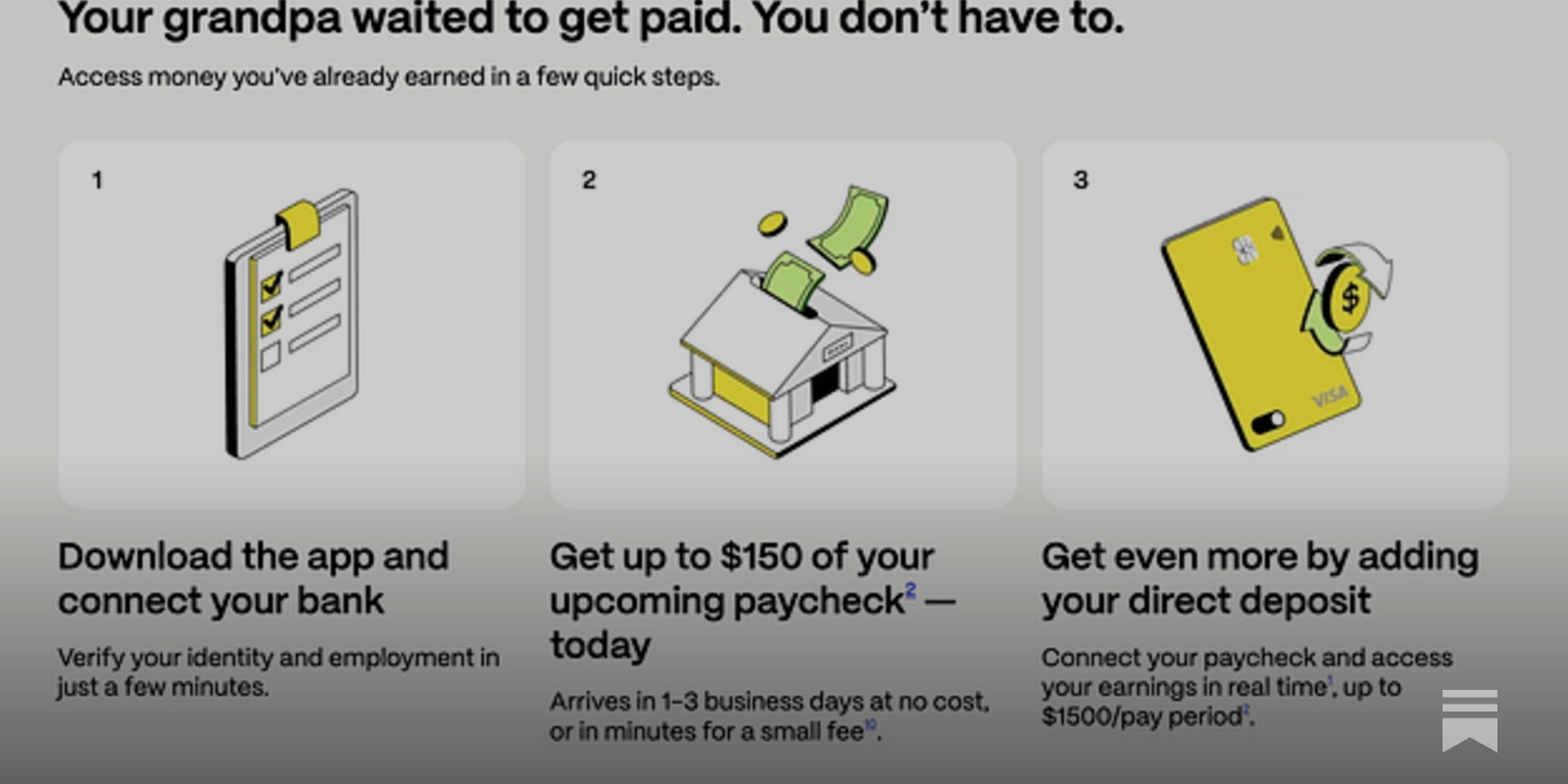
EarnIn is sometimes referred to as an “Earned Wage Advance” service. Though, unlike some others in the broader category, EarnIn does not integrate with employers’ payroll or time and attendance systems.
Rather, EarnIn attempts to verify a user’s income and employment, by examining direct deposit transaction data in their linked external bank account, by using GPS location and Bluetooth data to estimate a user’s time spent at work, if they work in a fixed location, and/or by having a user provided a work email address.
While repayment is theoretically optional, as EarnIn would have no recourse, such as reporting non-payment to the credit bureaus or a collections agency, this is anything but clear to users of the EarnIn app, Colorado’s complaint argues. During the process of taking a Cash Out, users must agree to a preauthorized debit of the amount advanced, plus any expedited funding fee and/or tips.
Though users technically can revoke this ACH authorization, the fact that they have this right isn’t presented to users during the Cash Out process, but rather is included in linked terms and conditions few users are likely to actually read. And users who do wish to revoke their ACH authorization must do so three or more days before the scheduled transaction date by emailing EarnIn’s customer support.
Similarly, EarnIn’s marketing claims that it carries “no interest” and “no mandatory fees” is technically true, but is not the reality for many of the app’s users, the Colorado complaint argues. Further, EarnIn has extensively marketed to users the ability to “access your pay today,” to get “instant” funds, and to get funds “the same day you work” — when, in reality, this speed of access was only possible by paying the additional, undisclosed Lightning Speed fee.
The Colorado complaint highlights this contradiction specifically, noting:
EarnIn tells consumers that they can ‘Make any day payday with EarnIn’ and that there no ‘hidden’ or ‘mandatory fees.’ For a consumer to access their pay on the same day requested, they would have to pay the Lightning Speed fee. In the fine print of the advertisement EarnIn discloses that ‘[f]ees apply to use Lightning Speed,’ a direct contradiction to the larger text of the advertisement, and a fact that would not be immediately understood by a consumer as ‘Lightning Speed’ is not defined nor explained.
Like other small-dollar lending services, rather than explicitly charge interest, EarnIn collects a markup on the optional Lighting Speed fee, which, given the nature of the transactions, many users opt for, as well as offering users the option to leave “tips.”
EarnIn leverages either Real-Time Payments (RTP) rails or push-to-card via debit rails if a user opts for the optional Lightning Speed. But while these capabilities cost EarnIn, on average, $0.075 or $0.20 per transaction, respectively, EarnIn charges users significantly more.
Initially, EarnIn charged as little as $1.99 for Cash Outs up to $24. But EarnIn has hiked these fees multiple times, and now charges $4.99 for Cash Outs up to $75 and $6.99 for those over $75.
According to the Colorado complaint, EarnIn leverages “dark patterns” to manipulate users and to make it more difficult to avoid tipping. Examples of these “road blocks” highlighted in the complaint include:
As of 2023, in the EarnIn app, a consumer attempting to get a loan
under the default settings had to make at least eighteen separate taps to complete the transaction and reduce the tip to $0.
There is an alternative method to leave a $0 tip, via the “Custom
tip” feature, but EarnIn made this option difficult to access by visually deemphasizing it and positioning it near devices’ “home” button.
Using language and imagery such as “Tip to pay it forward,” “Your generosity supports the service + helps,” “Your tips make a difference,” and “[t]he APR for this cash out is 0%. Your tips help support us.”
While Lightning Speed and tipping are, in theory, both optional, in practice, users nearly always ended up paying something. According to the Colorado suit, users were charged either a tip or an expedite fee for more than 92% of transactions, with an average APR of nearly 388%.
And, although the advances are “non-recourse,” EarnIn successfully collects on nearly all transactions — 99.18%, according to the complaint, which, Colorado argues, “demonstrat[es] that EarnIn’s advances function as high cost loans, not voluntary payments.”
The share of EarnIn users incurring fees — despite the product being marketed as 0% APR — is hard to reconcile with Andreessen investor Rampell’s favorable description of EarnIn vs. “opaque systems and steep fees” associated with payday loans, which, Rampell says, can be “extremely difficult” for borrowers to extricate themselves from.
According to Colorado’s suit, EarnIn’s Cash Out product “trapped many consumers in extreme cycles of high-cost reborrowing.” The suit gives an example of one consumer in the state, who took out a whopping 1,151 loans, paying a total of $4,038.50 in Lightning Speed expedited funding fees on loans that averaged the equivalent of 1,421% APR.
Another Colorado user, the suit says, took out 1,033 loans, paying $8,561.22 in tips and fees at an average APR of 1,539% . These types of usage patterns demonstrate “the severe and repeated financial harm caused by EarnIn’s illegal lending model,” the Colorado complaint argues.
In aggregate, from January 2023 through July 2025, EarnIn extended 3.1 million loans to 56,778 users in Colorado — an average of nearly 55 transactions per person during the time period. EarnIn lent more than $300 million and collected more than $16 million from Colorado users in Lightning Speed fees and in tips.
Ultimately, the Colorado complaint argues that “EarnIn’s Cash Outs are loans under Colorado law, and EarnIn’s contention that its product is not a loan based on its disclaimer of any legal repayment obligation lacks any real-world significance given how the Cash Out transactions actually operate in practice.”
Colorado further argues that “EarnIn was not working with companies here in providing consumers with funds but acted as a third-party lender and charged illegally high rates, used deceptive design strategies to extract some charges, and trapped consumers in repeat borrowing. Colorado will continue to stand up for consumers and hold companies accountable when they violate our credit laws or attempt to evade them through misleading practices.”
Colorado’s suit alleges EarnIn assesses finance charge in excess of that permitted by Colorado law, that EarnIn failed to make legally required disclosures to Colorado borrowers, that EarnIn made supervised loans to consumers without obtaining the requisite license, that EarnIn violated the state’s Deferred Deposit Loan Act, that EarnIn engage in unfair and deceptive trade practices, and that EarnIn made false or misleading statements concerning price.
The suit seeks a court order enjoining EarnIn from violating relevant Colorado laws, for EarnIn to refund amounts charged in excess of state law, fees, costs, and penalties, and other relief the court deems to be just.
Fintech Business Weekly is made possible by the generous support of paying subscribers — bringing you independent analysis of banking, fintech, and crypto without fear or favor.
You can support my work by becoming a paying subscriber if you aren’t already. Paying subscribers enjoy:
access to the entire archive of nearly six years of newsletters
extended versions of the weekly newsletter, with additional content and analysis
and (for founding member tier) quarterly personal 1:1 fintech Q&A / strategy calls with me, tapping into my unparalleled knowledge of the intersection of banking and fintech and experience working in the sector, including helping to launch Goldman Sachs’ retail bank Marcus
Support Fintech Business Weekly
You can also support Fintech Business Weekly by sponsoring a newsletter or podcast, putting you in front of 93,000+ of the most influential decision makers in banking, fintech, and crypto. Learn more about sponsor opportunities or request a media kit by dropping me an email.
Q2 Quarterly Banking Profile: Five Quick Takeaways
The FDIC released its quarterly banking profile, which is always worth a read, for the second quarter.
The profile provides an aggregate snapshot about the overall health of the 4,238 institutions whose deposits are insured by the FDIC, who, collectively, hold more than $26 trillion in assets and saw a total net income of more than $90 billion in the second quarter.
Net income was up 12% vs. Q1 2026, with lower provisions and realized gains on securities helping to drive the improvement, somewhat offset by increases in non-interest expense and applicable income taxes.
Overall net interest margin was basically flat quarter over quarter (up 1 basis point vs. Q1 2026), though community banks saw NIM grow by 10 basis points, to 3.81%.
Unsurprisingly, given that interest rates haven’t changed, unrealized losses on securities changed little, edging up slightly to $326.7 billion vs. $325.1 billion in Q1 2026.
Aggregate credit quality has remained benign, with asset quality actually improving slightly in Q2. Overall, institutions reported a 9 basis point decline in their past-due and non-accrual rate, to 1.44%. Net charge off rate also declined by 2 basis points, to 0.57%.
And finally, the FDIC’s deposit insurance fund stands at $161.1 billion, making the DIF reserve ratio 1.48% — above the statutory minimum of 1.35%, but still below the designated target reserve ratio of 2%.
[Paid Subscriber Exclusive] Nissan Withdraws ILC App, State Associations Plan BankChain Alliance, FDIC Defines “Unsafe or Unsound Practice” For First Time
Automaker Nissan withdrew its application to charter a Utah industrial loan company and its corresponding application to the FDIC for deposit insurance last week, on August 19th. Nissan’s application had been outstanding for more than a year, as it originally applied in June 2025.
Recent applications to the OCC to form national banks have been decisioned, one way or the other, substantially more quickly than has historically been the case.
What's Your Reaction?