









Doomsday Friday
Subscribe If you are reading this post, congratulations! You survived Doomsday. On 4 November 1960, three researchers at the University of Illinois published a paper in Science titled “Doomsday: Friday, 13 November, A.D. 2026” (von Foerster et al. 1960). We have reached that Friday. The Doomsday Equation In their paper, the authors collected 24 estimates of world population from the time of Christ through 1958 and fit a curve to them that wound up growing faster than an exponential. In an exponential world, population doubles over a fixed interval. In the von Foerster world, the doubling interval shrinks toward zero as time approaches a singularity. They estimated the date of that singularity at A.D. 2026.87, give or take 5 and a half years, and they settled on Friday, 13 November 2026. The authors had some fun with their equation. Charlemagne, they calculated, could have predicted doomsday to within 300 years, and Napoleon to within 30 years. Extrapolating backward, they found a lone “Adam” about 200 billion years in the past, roughly eight times the age astronomers of 1960 assigned to the universe. The authors also took sides in the population debate of their day. Technology would keep pace with growth, they argued, so our great-great-grandchildren would face no starvation, but “they will be squeezed to death.” To avoid the squeeze, they proposed a “peoplo-stat” to hold world population constant, and noted proposals for legislation and heavy taxes on larger families among the options, reflecting the emerging visions of an over-population apocalypse emerging at that time. How did the doomsday forecast do? For about three decades, the authors’ forecast had an impressive track record. Their methods implied ~2.8 billion people in 1960 and ~5.0 billion in 1990. The world had 3 billion people in 1960 and exceeded 5 billion by 1987. After that, the methodology did not work out so well — it predicted 26.6 billion in 2020, and more than 200 billion people today, Doomsday. The UN estimates world population in 2026 at about 8.3 billion, with a projected peak of about 10.3 billion in the 2080s. Instead of a squeeze, families across the world chose to have fewer children amid rising incomes, expanding schooling, and urbanization — see this excellent essay on the “baby bust” by Jesús Fernández-Villaverde, just out this week. When Prediction Helps Decision Makers Doomsday Friday offers me a good excuse to look back at a big project on prediction in the earth sciences that Dan Sarewitz, Rad Byerly, and I led a quarter century ago. That project — sponsored by the U.S. National Science Foundation — led to our book, Prediction: Science, Decision Making, and the Future of Nature (Island Press, 2000). With our collaborators, we examined ten case studies, from weather and floods to asteroids, earthquakes, nuclear waste, acid rain, and climate change. In our concluding chapter, we argued that most people treat a prediction as a product, a piece of information that scientists hand to decision makers. We argued for a broader view, in which scientists, communicators, and decision makers take part together in a process of research, communication, and decision making. Under that view, the participants succeed by making better decisions, which may or may not depend upon better predictions. Two cases help to illustrate the difference. In 1997, forecasters predicted a record 49-foot crest for the Red River at Grand Forks, North Dakota. Residents remembered surviving 48.8 feet in 1979 and took comfort in a forecast only a few inches above that record. The river crested at 54 feet and caused $2 billion in damages. The forecasters missed by about 10%, in line with their historical error, but nobody communicated or understood that uncertainty. A good prediction contributed to poor decisions, because the process failed. At Parkfield, California, seismologists assigned a 95% probability to an predicted earthquake in a particular time period, but it did not happen. Yet, even so, officials and scientists worked together around the prediction and improved earthquake preparedness. Parkfield developed better earthquake preparation despite the bad prediction because the process worked. Effective use of predictions depends on a successful process of decision making, and not a successful prediction product. Five Criteria for the Effective Use of Prediction in Decision Making We developed five criteria to help assess contexts in which prediction has the most potential to contribute to improved decision making: Known skill. Decision makers know the skill of the predictions. Experience. Decision makers have experience with understanding and using predictions of that kind. Short characteristic time. The predicted event occurs relatively soon after the prediction is made, so that people can compare many predictions with actual outcomes. Limited alternatives. Decision makers have few alternatives to prediction. Understood consequences. Decision maker




Subscribe




If you are reading this post, congratulations!
You survived Doomsday.
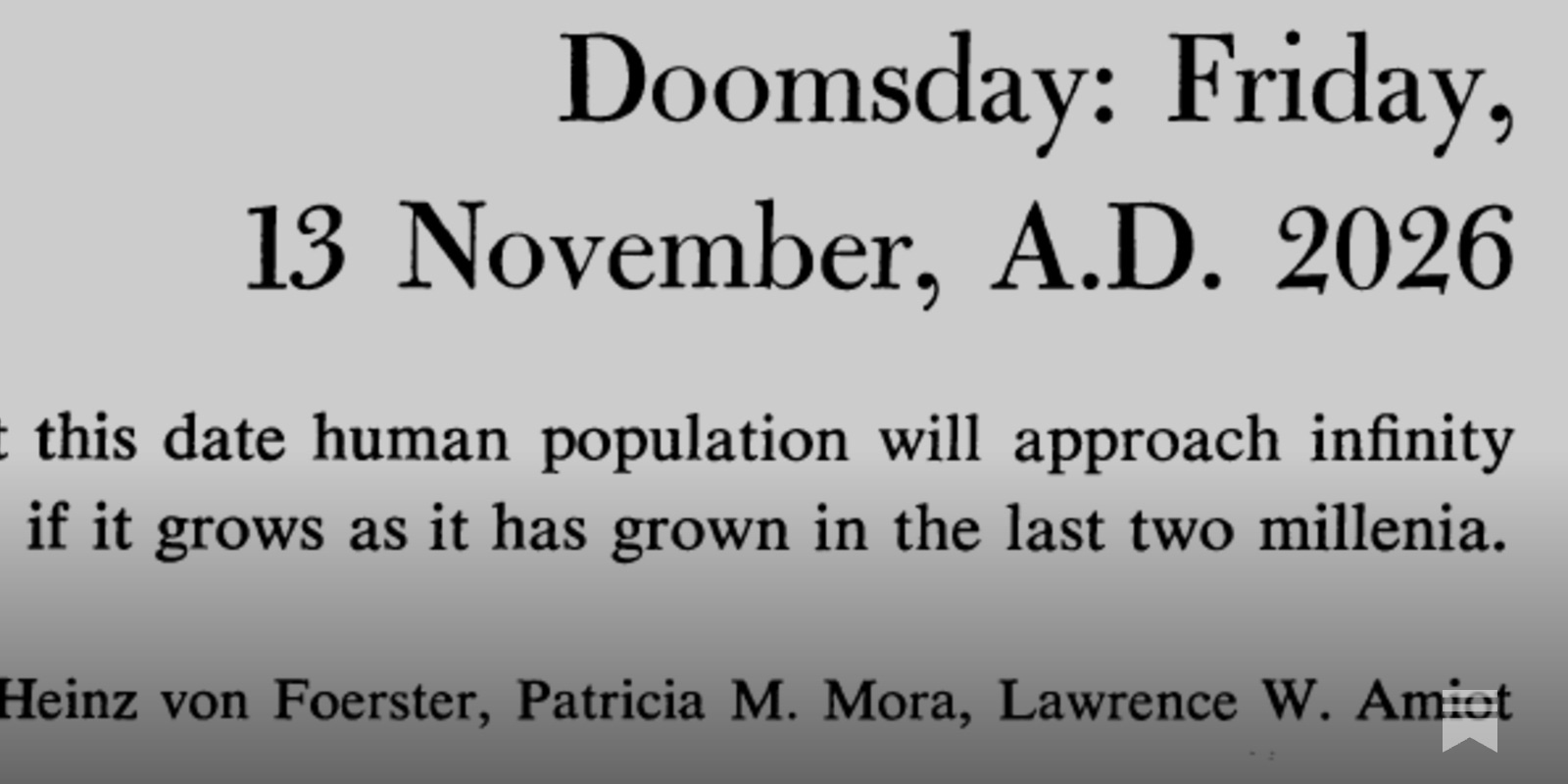
On 4 November 1960, three researchers at the University of Illinois published a paper in Science titled “Doomsday: Friday, 13 November, A.D. 2026” (von Foerster et al. 1960).
We have reached that Friday.
The Doomsday Equation
In their paper, the authors collected 24 estimates of world population from the time of Christ through 1958 and fit a curve to them that wound up growing faster than an exponential.
In an exponential world, population doubles over a fixed interval. In the von Foerster world, the doubling interval shrinks toward zero as time approaches a singularity. They estimated the date of that singularity at A.D. 2026.87, give or take 5 and a half years, and they settled on Friday, 13 November 2026.
The authors had some fun with their equation.
Charlemagne, they calculated, could have predicted doomsday to within 300 years, and Napoleon to within 30 years. Extrapolating backward, they found a lone “Adam” about 200 billion years in the past, roughly eight times the age astronomers of 1960 assigned to the universe.
The authors also took sides in the population debate of their day. Technology would keep pace with growth, they argued, so our great-great-grandchildren would face no starvation, but “they will be squeezed to death.”
To avoid the squeeze, they proposed a “peoplo-stat” to hold world population constant, and noted proposals for legislation and heavy taxes on larger families among the options, reflecting the emerging visions of an over-population apocalypse emerging at that time.
How did the doomsday forecast do?
For about three decades, the authors’ forecast had an impressive track record. Their methods implied ~2.8 billion people in 1960 and ~5.0 billion in 1990. The world had 3 billion people in 1960 and exceeded 5 billion by 1987.
After that, the methodology did not work out so well — it predicted 26.6 billion in 2020, and more than 200 billion people today, Doomsday.
The UN estimates world population in 2026 at about 8.3 billion, with a projected peak of about 10.3 billion in the 2080s. Instead of a squeeze, families across the world chose to have fewer children amid rising incomes, expanding schooling, and urbanization — see this excellent essay on the “baby bust” by Jesús Fernández-Villaverde, just out this week.
When Prediction Helps Decision Makers
Doomsday Friday offers me a good excuse to look back at a big project on prediction in the earth sciences that Dan Sarewitz, Rad Byerly, and I led a quarter century ago. That project — sponsored by the U.S. National Science Foundation — led to our book, Prediction: Science, Decision Making, and the Future of Nature (Island Press, 2000).
With our collaborators, we examined ten case studies, from weather and floods to asteroids, earthquakes, nuclear waste, acid rain, and climate change.
In our concluding chapter, we argued that most people treat a prediction as a product, a piece of information that scientists hand to decision makers.
We argued for a broader view, in which scientists, communicators, and decision makers take part together in a process of research, communication, and decision making. Under that view, the participants succeed by making better decisions, which may or may not depend upon better predictions.
Two cases help to illustrate the difference.
In 1997, forecasters predicted a record 49-foot crest for the Red River at Grand Forks, North Dakota. Residents remembered surviving 48.8 feet in 1979 and took comfort in a forecast only a few inches above that record. The river crested at 54 feet and caused $2 billion in damages. The forecasters missed by about 10%, in line with their historical error, but nobody communicated or understood that uncertainty. A good prediction contributed to poor decisions, because the process failed.
At Parkfield, California, seismologists assigned a 95% probability to an predicted earthquake in a particular time period, but it did not happen. Yet, even so, officials and scientists worked together around the prediction and improved earthquake preparedness. Parkfield developed better earthquake preparation despite the bad prediction because the process worked.
Effective use of predictions depends on a successful process of decision making, and not a successful prediction product.
Five Criteria for the Effective Use of Prediction in Decision Making
We developed five criteria to help assess contexts in which prediction has the most potential to contribute to improved decision making:
Known skill. Decision makers know the skill of the predictions.
Experience. Decision makers have experience with understanding and using predictions of that kind.
Short characteristic time. The predicted event occurs relatively soon after the prediction is made, so that people can compare many predictions with actual outcomes.
Limited alternatives. Decision makers have few alternatives to prediction.
Understood consequences. Decision makers understand the outcomes of various courses of action, including the likelihood and effects of false alarms and missed events.
When these criteria are not met, we suggest that decision makers seek alternatives to prediction for robust and effective decision making.
Weather forecasters and the process that these predictions take place in meet all five criteria, and we thus gave weather forecasting the lone spot in our prediction hall of fame.
The Doomsday Forecast Versus the Five Criteria
Looking back, the doomsday forecast met none of the five criteria.
Known skill. The authors reported a 7% root-mean-square deviation between their curve and the historical estimates. Was that good? Bad? It was impossible to judge because no one could know the skill of population forecasts.
Experience. No decision maker had experience with 66-year forecasts of global population.
Short characteristic time. The doomsday prediction was for 66 years into the future, but its deviation from reality was observable well before that.
Limited alternatives. Of the many issues implicated by population growth rates, effective decision making does not require accurate long-term prediction of global population.
Understood consequences. Nobody in 1960 understood the consequences of efforts to control global population. Later governments that pursued coercive population programs — such as India’s forced sterilizations of the mid-1970s to China’s one-child policy — imposed enormous human costs.
The authors framed their result as a conditional: population would approach infinity if it continued to grow as it had for two millennia. In that sense they demonstrated that the trend could not continue for another century — and the trend did not.
The use of prediction in policy comes with another risk — as John Robinson warned in 1982, decision makers who base present choices on forecasts can create an appearance of inevitability and may lose sight of the wide scope of present choice.
As John Connor incanted in Terminator 2:
“The future’s not set. There’s no fate but what we make for ourselves.”
Have a great weekend!
Comments welcomed!
If you also survived doomsday, please click the “❤️ Like” button!
Paid THB subscribers can access below a PDF of the concluding chapter to our Prediction book — and can find plenty more good stuff at the
What's Your Reaction?